GILMORE'S GUN goes on sale for $1m By David Usborne in New York Published: 15 July 2006
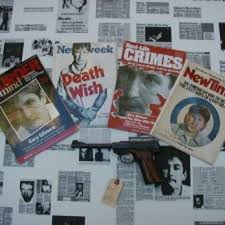
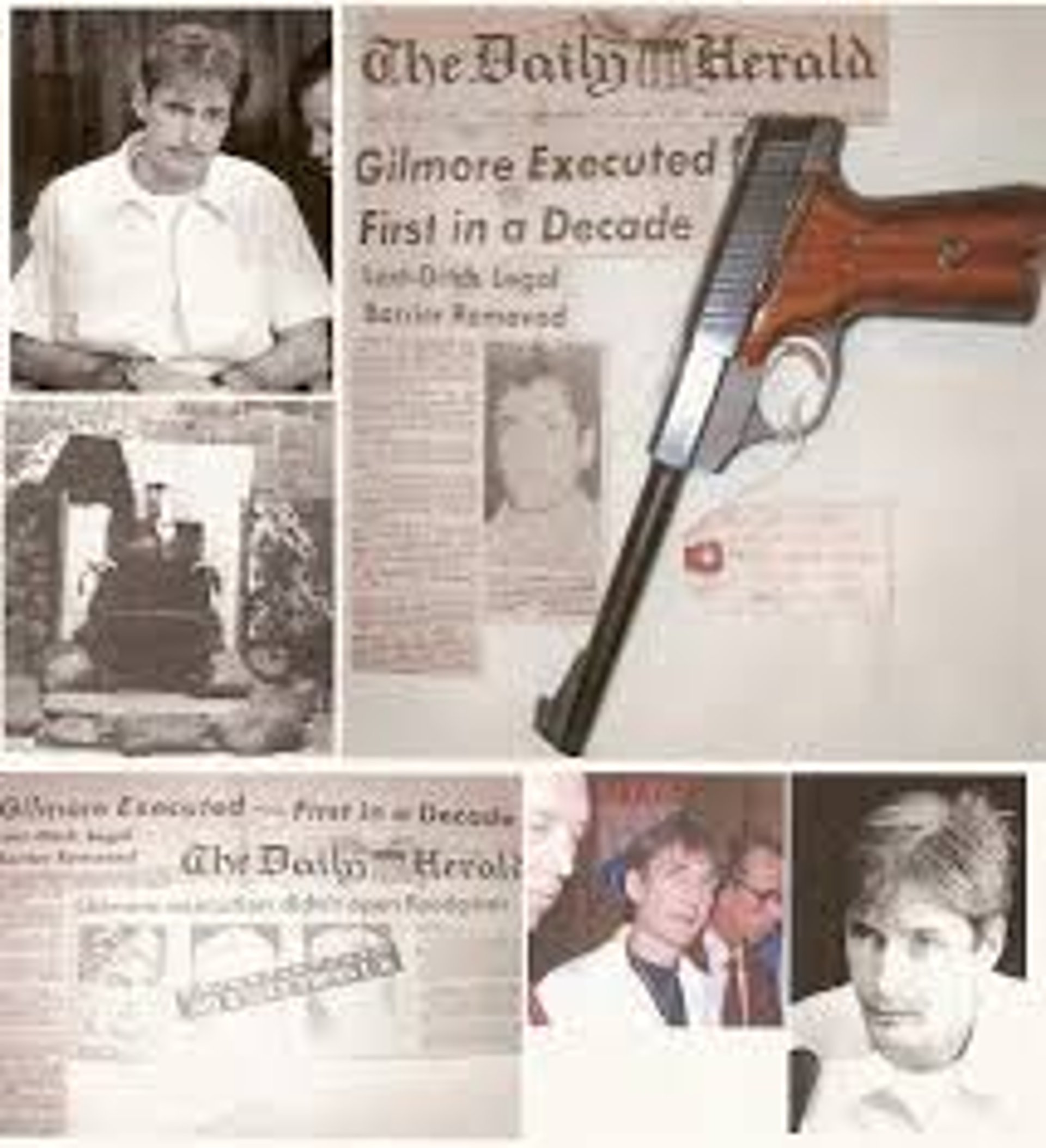
Scholars and supporters of capital punishment in the United States are being given the chance to purchase at auction what may be the rarest of all death-penalty souvenirs - the handgun purportedly used by Gary Gilmore to murder a motel clerk in Utah almost 30 years ago.
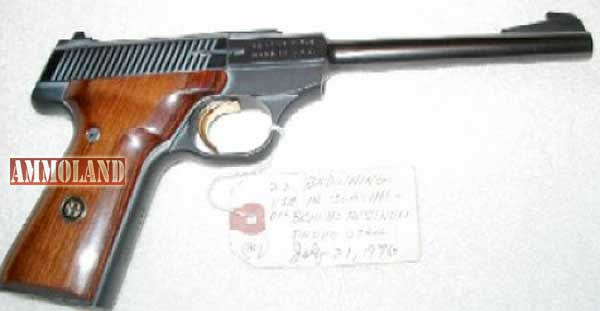
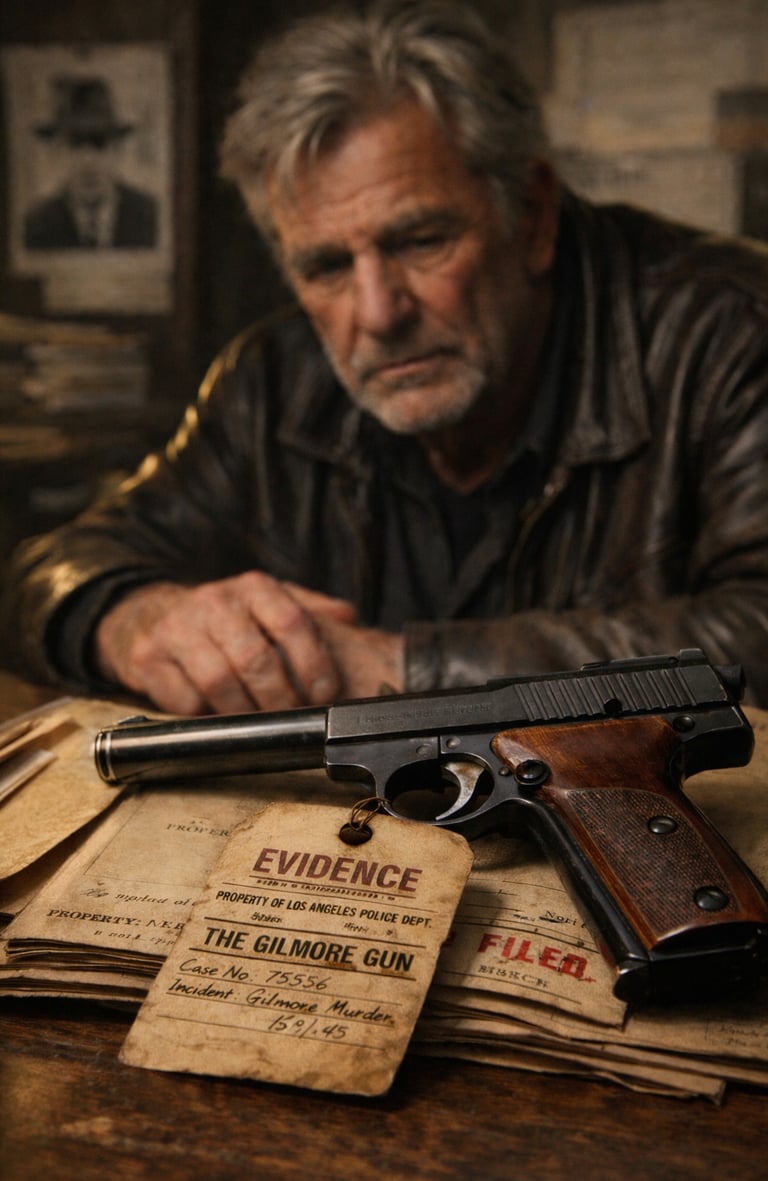
The first man to be sentenced to death after the US Supreme Court reinstated the death penatly in 1977, Gilmore was killed by firing squad. A morbid mythology has since clung to him, spurred partly by Norman Mailer's, The Executioners Song, which became a film starring Tommy Lee Jones. After Gilmore was dead, the police returned the pistol to the gun shop he stole it from Spanish Fork, Utah. In 2002, it was bought by a local bail bondsman, Dennis Stilson. Mr. Stilson has now placed the gun for sale in an internet auction on the site, best known for featuring artwork by prisoners on death row. Still attached to the gun is the original law enforcement evidence tag, Mr. Stilson says. He also has the official FBI file on it. The starting bid on the gun last night was listed as $1m (£545,000). Mr Stilson has said that he hoped to use the proceeds to build a youth centre. Whether that will happen is uncertain, however. Under Utah law, any money paid for it should go to the Crime Victims Reparations Fund.
Gun Purportedly Used by Gilmore Auctioned Friday July 14, 2006 4:16 AM By DEBBIE HUMMEL Associated Press Writer SALT LAKE CITY (AP) -
The gun purportedly used by executed killer Gary Gilmore to commit his crimes is being offered for sale on a murder collectibles auction site for a minimum bid of $1 million. The owner put the .22-caliber Browning pistol on murderauction.com Wednesday with a description reading: ``The actual pistol used by Gary Gilmore for two murders. Absolute documentation.'' Gilmore was the first person in the country executed after a Supreme Court decision allowed states to restore the death penalty in 1976 after a 10-year moratorium. ____________________________________________________________________________________________ Gary Gilmore's gun available on murder auction site By Debbie Hummel ASSOCIATED PRESS 4:37 p.m. July 13, 2006 SALT LAKE CITY – The gun that executed killer Gary Gilmore purportedly used to commit his crimes is being offered for sale on a murder collectibles auction site for $1 million. Dennis Stilson, a Spanish Fork bail bondsman, says he wants to use money from the sale to open a youth center, but the state would likely confiscate the proceeds under a Utah law that prohibits profiting from crime.The gun was put up for auction on the site murderauction.com Wednesday with a minimum bid of $1 million and a description reading: “The actual pistol used by Gary Gilmore for two murders. Absolute documentation.”Gilmore was executed by a Utah firing squad in 1977 for the shooting death two years earlier of Provo motel clerk Bennie Bushnell. Gilmore also was charged with capital murder – but never tried – in the killing of Brigham Young University law student Max Jensen, a part-time Orem gas station attendant, the night before the Bushnell murder.Gilmore was the first person in the country executed after a U.S. Supreme Court decision allowed states to restore the death penalty in 1976 after a 10-year moratorium. His story was the subject of the Norman Mailer book, “The Executioner's Song,” which was later made into a movie of the same name starring Tommy Lee Jones as Gilmore.After the Gilmore case was closed, authorities returned the gun to the owner of the Spanish Fork gun store from which Gilmore had stolen it. Stilson says he tried to sell the gun for the owner, Gordon Swan, but eventually bought the gun himself in 2002.Stilson won't say how much he paid for .22-caliber Browning pistol, but says he turned down an offer in 2002 of $500,000 through a different Internet auction.The gun still has a law enforcement evidence tag attached, Stilson said. He also has the FBI evidence file for the gun and a 2004 letter from the John M. Browning Firearms Museum in Ogden, he said. The director of the museum wrote the letter saying the serial numbers on the gun don't appear to have been altered.Stilson, 50, said he wants to sell the gun to raise money to open a youth center. He said over the years he's met a lot of troubled teens.“I want to be the guy to help them. Just (give them) somewhere they can go to learn life skills, have art and music. Kids need to have something,” he said.Dave Larsen, a salesperson at a local gun store, said the model of pistol Stilson has would sell for between $250 and $350 depending on its condition. Stilson suspects the amount is more like $1,000, but because of his gun's historical value he can't guess at the price it could fetch.“There's people out there, that if they're aware this gun is out there they'll pay that,” Stilson said of his $1 million minimum bid on the Web site.If the gun sells, it's unlikely that Stilson would be able to keep the money.In 2004, Utah enacted a law prohibiting a person from profiting from the sale or transfer of memorabilia that is any tangible property of a person convicted of a first-degree felony or capital offense, said Sharel Reber, an assistant attorney general for Utah.According to the law, the money from such a sale would have to go to the Utah Crime Victims Reparation Fund, she said. Anyone caught profiting from the sale of that kind of item could be assessed a civil penalty of up to $1,000 per item sold or up to three times the amount of the profit over fair market value, Reber said.“It appears he's on notice about the law,” said Cheryl Luke with the Utah Department of Public Safety and the attorney who would likely file any case for the crime victims fund.Luke said she would not file anything official unless the gun is sold for well over its fair market value.Stilson said he first learned of the law when a newspaper reporter contacted him about the auction Wednesday.“If that's the case, I guess I'd move to a state that doesn't have that law,” he said.Stilson has tried to sell the gun before. Once at a Las Vegas gun show. A second time, he established an essay contest offering the gun as a prize for entrants willing to pay the $108 entry fee. He called off the contest after he didn't get enough entries to merit awarding the gun, and returned the fees he had collected.Stilson has also written a book about the gun called “The Gilmore Gun and I.” He said he has recently finished a second version, “The Gilmore Gun: My Side of the Story.” He is looking for a publisher. _________________________________________________________________
Gun said used by killer Gary Gilmore listed on auction website for $1 million Insider Edition Associated Press Friday, July 14, 2006
Gilmore gun listed on auction website for $1-million From the Magazine | The Law Much Ado About Gary Sunday, January 13, 2002 (AP) Dealer hawking gun with a past at Las Vegas show (01-13) 14:34 PST LAS VEGAS (AP) -- A dealer at the Las Vegas Gun Show was accepting offers Saturday on the murder weapon used by Utah killer Gary Gilmore, who was put to death 25 years ago this week in one of the most high-profile executions in the nation's history. Dennis Stilson, a gun dealer, bail bondsman and custom golf club builder from Spanish Fork, Utah, has no set price for the .22-caliber Browning pistol, but said he turned down an offer of $500,000 during a July Internet auction. "I'd probably take that money now," the 45-year-old told the Las Vegas Review-Journal while handling the handgun at his booth at Cashman Center near downtown. "But how do you know how much a one-of-a-kind is worth?" Accused in the murders of two men, Gilmore was convicted and became the first person to be executed after the U.S. Supreme Court allowed the reinstatement of the death penalty in 1976. He was executed by a firing squad Jan. 17, 1977. "Let's do it," were his final words. The case was chronicled in writer Norman Mailer's book "The Executioner's Song," and dramatized in the recent HBO movie "Shot In the Heart." After the case was adjudicated, authorities returned the gun to the owner of the Spanish Fork gun store from which Gilmore stole it, Stilson said. Stilson, who is selling the pistol on behalf of that owner, has copies of an FBI report with the gun's serial number, authenticating the gun's history. "People passing by here have been stopped in their tracks all day long as soon as they see this," Stilson said. "I think it's eerie for a lot of people." Stilson, however, said he hasn't sought publicity for the item in Utah out of respect for the families of Gilmore's victims. The murder victims lived in nearby Orem and Provo. "Of course, this is a piece of a tragedy," he said. "But really, this is no different than selling tickets to a movie about Vietnam. That's a tragedy, too, and people make money from that." Show organizer Claude Hall said in 25 years of operating gun shows, he's never seen a murder weapon for sale. "I know I never seen anybody turn down a half-million dollars for anything around here neither," he said.
Execution No. 1,000 — since Gilmore
Count began with Gilmore who died by a
By Bradley Brooks
Associated Press
With those last words, convicted
After a 10-year moratorium, Gilmore in 1977 became the first person to be executed following a 1976 U.S. Supreme Court decision that validated state laws to reform the capital punishment system. Since then, 997 prisoners have been executed, and next week, the 998th, 999th and 1,000th are scheduled to die.
Robin Lovitt, 41, will likely be the one to earn that macabre distinction next Wednesday. He was convicted of fatally stabbing a man with scissors during a 1998 pool-hall robbery in
Ahead of Lovitt on death row are Eric Nance, scheduled to be executed Monday in
Gilmore was executed before a
While his case was well-known, most today could probably not name even one of the more than 3,400 prisoners — including 118 foreign nationals — on death row in the
The focus of the debate on capital punishment was once the question of whether it served as a deterrent to crime. Today, the argument is more on whether the government can be trusted not to execute an innocent person.
Thomas Hill, an attorney for a death row inmate in
"We have a criminal system that makes mistakes. If you accept that proposition, that means you have to be prepared for the inevitability that some are sentenced to death for crimes they didn't commit," said Hill.
But advocates of the death penalty argue that its opponents are elitist liberals who are ignoring the real victims.
"Since 1999 we've had 100,000 innocent people murdered in the
Race is also a key question in the debate. Since 1976, 58 percent of those executed in the
Some supporters say ending the death penalty would be harmful to poor minorities, who are disproportionately murder victims.
"Increasingly violent crime is primarily for the working class folks, poor people and people of color," Paranzino said.
Opponents of capital punish ment also point to the unfair role of class and race in death penalty cases. "There is tremendous arbitrariness to the death penalty. . . . the race of the victims has a lot to do with who winds up getting executed," said Barry Scheck, co-founder of the New York-based Innocence Project, a legal clinic that seeks to exonerate inmates through DNA testing.
Death sentences nationwide have dropped by 50 percent since the late 1990s, with executions carried out down by 40 percent, according to the Death Penalty Information Center. Twelve states do not have the death penalty, and at least two states —
An October
Still, some powerful political forces are looking to speed up the trying and executing of prisoners. Both houses of the U.S. Congress are considering bills that would lessen the ability of defendants in capital cases to appeal to federal courts.
Proponents of the legislation say such appeals add up to 15 years to the process of executing a prisoner. Detractors say the law will not allow federal courts to review most cases and will result in innocent people being put to death.
Since 1973, 122 prisoners have been freed from death row. The vast majority of those cases came during the last 15 years, since the use of DNA evidence became widespread. While there is no official proof an innocent person has been executed, opponents of the death penalty say the number of prisoners whose convictions have been reversed should fuel skepticism.
"I don't think any rational person seriously examining the evidence can have any confidence that an innocent hasn't already been executed," said Scheck.
Using post-conviction DNA evidence, the Innocence Project has helped in more than half of the 163 cases vacated — 14 of which were from death row. "We've demonstrated that there are too many innocent people on death row," Scheck said.
But that argument does not impress Charles Rosenthal, district attorney for Harris County, Texas, which has sent more prisoners to the death chamber — 85 — than any other U.S. county and all but two states, Texas and Virginia, according to Texas Department of Criminal Justice statistics.
"I don't know about every death penalty case in
Scheck believes Rosenthal's claim is based "more on faith than fact." He noted that the police DNA lab in
"What kind of confidence can you have when the jurisdiction that executes more people than any other is fraught with unreliable testing results?" Scheck said.
In at least two cases, questions are being raised about whether an innocent person was put to death. In
In
In
"Most of the time there is testing, it confirms the guilt of the defendant," Joyce said.
Virginia Gov. Mark Warner is examining Lovitt's case, and could decide whether or not to grant clemency over the weekend. It would be the only likely way Lovitt could avoid execution. In October, the U.S. Supreme Court refused to reconsider the case.
DNA tests on the scissors used in the stabbing were inconclusive, and the scissors were later thrown away because of a lack of storage space. One of his lawyers, former independent counsel Kenneth Starr, said though he supports the death penalty in principle, it should not apply to Lovitt for reasons "including above all right now the destruction of the DNA evidence."
Sunday, January 13, 2002 (AP)
Dealer hawking gun with a past at Las Vegas show
(01-13) 14:34 PST LAS VEGAS (AP) --
A dealer at the Las Vegas Gun Show was accepting offers Saturday on
the
murder weapon used by Utah killer Gary Gilmore, who was put to death 25
years ago this week in one of the most high-profile executions in the
nation's history.
Dennis Stilson, a gun dealer, bail bondsman and custom golf club
builder
from Spanish Fork, Utah, has no set price for the .22-caliber Browning
pistol, but said he turned down an offer of $500,000 during a July
Internet auction.
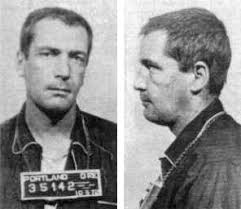
_________________________________________________________________________________________________ Posted —The Ballad of Gary Gilmore To all appearances, the long wait seemed almost over for Gary Mark Gilmore last week. Just as he had been demanding ever since his conviction two months ago for the murder of a 25-year-old motel clerk in The pardon-board hearing took place, like some futuristic fantasy, on television. At Gilmore was led in, his tattooed wrists manacled. He wore a white prison uniform, and he looked somewhat gaunt from his twelve-day hunger strike (he has lost about 201bs.). Ex-Judge George W. Latimer. 75. chairman of the board, asked Gilmore if he had anything to say. Answered Gilmore: "Your board dispenses privileges that I always thought were sought, deserved and earned. I haven't earned anything. To paraphrase Shakespeare, this is much ado about nothing. I simply accepted my sentence." Gilmore repeated his earlier charge that Governor Calvin Rampton was a "moral coward" for staying his execution last month. As for the others who wanted to speak in his defense—the witnesses at the hearing included a right-to-life housewife and a vociferous representative of the Citizens Against Pornography and Other Crimes Committee —Gilmore was equally blunt: "All I have to say to all of them—the rabbis, the priests, the A.C.L.U.—I'd like them to butt out. It's my life and my death." "Courtroom graphics and Gilmore in chains," said TV Reporter John Hollenhorst as he sat in the studio of "Most people around here want the Gilmore story to disappear because they're embarrassed by the publicity," said the program's producer, Janice Evans. "But I think it's terrific." The next day's hearing before Judge Bullock was brisk. Again the manacled prisoner was asked whether he had anything to say. Gilmore rose shakily to his feet and made one request: "I understand, your honor, they are planning to seat me in a chair with a hood over my head. I don't want that. I don't want a hood, and I want to be standing." The judge said he did not have the authority to set the details of the execution but would notify Warden Samuel Smith of Gilmore's request. That left only the time to be set. "I'm going to set it at sunrise Monday," the judge said. "Do you request another time?" "I don't request anything," Gilmore said. Outside Though Gilmore has persistently disavowed all lawyers who tried to win him a reprieve, the decisive intervention came when Stanford Law Professor Anthony G. Amsterdam moved in the following day, on behalf of Gilmore's mother. So, for a time, the execution was called off. In the dingy foyer of the Utah State Prison, Gilmore's aunt, Ida Damico, and her daughter, Brenda Nicol, maintain a sort of vigil. They say, though, that if they had been on Gilmore's jury, they would have voted to convict. "The Indians had the right idea," says Brenda, a cocktail waitress in The family has already discussed the division of Gilmore's worldly possessions, including parts of his body. One of Brenda's children hopes to get Gilmore's pituitary gland. "I wish I could get his brain, "Aunt Ida says with a smile. "I always wanted to go to college." As Gilmore waits out the next round, book, magazine and television offers keep flooding in. Gilmore has fired his first agent, Dennis Boaz, who until recently was also his lawyer, in favor of his uncle, Vern Damico. Damico listened to a $5,000 bid from the National Enquirer, a $100,000 bid from David Susskind, and then accepted a more elaborate contract from Los Angeles Photographer and Entrepreneur Lawrence Schiller. For a $100,000 down payment, plus royalties, Schiller has arranged a package deal that includes a TV dramatization of Gilmore's life and death for ABC's Movie of the Week. As money comes in, along with celebrity, so do bills. Last week a --------------------------------------------------------------------------------------------- 30 years ago Shots heard 'round the Gary Gilmore's landmark execution marked the return of capital punishment and stoked the death row debate By Jeremiah Stettler Article Last Updated: Thirty years ago, a volley of gunshots outside the Utah State Prison triggered a new era in capital punishment, ending the life of convicted killer Gary Gilmore and reviving state-sanctioned executions across the country. violations," said Rick Halperin, chairman of Amnesty International's board of directors. "The death penalty institution is inherently flawed, brutally racist and prone to terrible mistakes. It is not now - nor ever has been or ever will be - a solution to violent crime in Protests 30 years after Gilmore Posted on It was 30 years ago today that Gary Gilmore was strapped to a chair before a firing squad and uttered his famous last words: "Let's do it." The controversial execution that marked the reinstatement of the death penalty in the The Killers On Nearly 24 hours earlier, a caravan of news vehicles—motor homes and tractor-trailers—pulled off of the interstate near Draper and rolled down the hill, through the towering security gate into the parking lot of the Utah State Prison. “Once we got inside the gate, we were going to be there till dawn, when the execution was scheduled,” says Gordon Godfrey, a former cameraman for KUTV, then Godfrey is also my father. I had known for some time that he was present at Gilmore’s execution, but interviewing him for this article was the first time we discussed it in any detail. “It turned into a full-blown circus, really beyond anything I had seen,” Godfrey says. Gilmore’s execution would be the first in the “No one had experienced anything like this, so no one knew what to expect,” says Godfrey. “What we didn’t fully realize at the time is that we were keeping watch on a scheduled death.” Inside the parking lot, the media set up equipment for live reports. ABC constructed a giant stage overlooking the prison yard for its star reporter, Geraldo Rivera. But mostly, they just waited around. In some of the trailers, there was drinking and copious amounts of pot-smoking. Godfrey had seen Gilmore only once, after his second suicide attempt while in prison. “They took him out of a van and led him down a ramp back into the prison. He was still pretty out of it from all the pills he had taken. He just had a blank stare on his face.” Weeks prior to the execution, KUTV had petitioned in federal court to be allowed to tape the execution but was denied. Instead, a pool of media personnel were allowed to view the aftermath of the execution. “Just as the state and the prison didn’t really know how to carry out an execution, we didn’t really know how to cover one.” At some point in the late evening, a U.S. Marshal’s car came through the gate. Inside was U.S. District Court Judge Willis W. Ritter, the legendary firebrand from “After Ritter delivered the stay, he got in his car and just tore out of the parking lot. Chris Bell [an NBC photographer] jumped out to get a shot of the car, and Ritter almost ran him over,” says Godfrey. “So Chris goes chasing after the car of the most powerful judge in the state, pounding on the hood, screaming, ‘You son of a bitch! You almost killed me!’” After the stay was delivered, the press corps fell into a holding pattern. Assuming that the execution was off, Godfrey went into the KUTV motor home to get some rest. “I must have fallen asleep, because the next thing I remember is someone yelling, ‘You have to get ready! The stay was overturned in The "Death Wish" The anniversary of Gary Gilmore’s execution passed with little fanfare and did not garner the attention that might be expected for a major anniversary of a historical event that still impacts not just Utah, but the nation. It came and went virtually unmentioned in American print and broadcast media. Both The Salt Lake Tribune and Deseret Morning News ran brief articles on Gilmore and the legacy of his execution, while local television news aired a few pictures of the vigil, but little else. “It is troubling that this milestone has received a lack of attention,” says Rick Halperin, chairman of Amnesty International USA, who flew in for the vigil. “Our continuing use of capital punishment says something very dark about us as a nation, and it’s frustrating that we choose not to discuss it.” Gary Mark Gilmore was a hapless, hopelessly violent ex-convict who spent more than half his life behind bars. On the evening of A few hours after the Bushnell murder, Gilmore was taken into police custody. He confessed to both killings at the Provo City Jail. He was charged with two counts of criminal homicide and aggravated murder. A court-ordered psychiatric evaluation diagnosed Gilmore with a severe antisocial personality disorder but found him fit to stand trial. Utah County Prosecutor Noall Wootton made it known he would push for the death penalty. Gilmore’s trial began on He was not the first to be sentenced to death in Indeed, he would go to great lengths to make sure that sentence was carried out. Gallons of ink have been spilled over Gilmore’s “death wish,” but for those closest to him in that final year, the reason behind his willingness to die was obvious: He accepted the just nature of his sentence and could not accept the idea of spending the rest of his life in prison. Since Gilmore’s execution, 124 death-row inmates have refused to actively appeal their sentences, most recently Robert Comer of For Gilmore, prison was an endless cycle of rape, violence, solitary confinement and brutal psychiatric treatment. “He told me ‘Prison life is no life,’” says Mike Esplin, who is now in private practice in After his trial, Gilmore told his lawyers that he did not want to make any sort of appeal. “The only time I was ever afraid to be in the same room as Gary Gilmore was the day I told him he would have to fire me,” Esplin says. Esplin and Synder insisted on an appeal, telling Gilmore it was their legal obligation. Under state law, all death sentences were subject to an automatic appellate hearing in front of the Utah Supreme Court. On Nov. 10, Attorney General Robert Hansen addressed and assured the court that “Then something truly unique happened,” says Esplin. “The court asked Gilmore to testify that he had released his appointed council, which he said he had. And that he did not wish to pursue any avenue of appeal, which he said he did.” Opening "The Floodgates" In many ways, Gilmore was right. The state of And yet, as the date neared, nothing and no one was able to stop the execution. One last effort was made Jan. 16, when the Utah ACLU and a group of lawyers representing other condemned men got an appearance before 3rd District Judge Willis Ritter.Much
What's to become of Gilmore, the killer who wanted to die? Will they just do away with Gilmore, or will they give him another try?
The Salt Lake Tribune
Defiant toward those who might spare him, Gilmore greeted his death with the words, "Let's do it."
So with a black hood over his head, Gilmore became the first man executed since the U.S. Supreme Court - frustrated at inequities in sentencing - outlawed the practice in 1972 as "cruel and unusual in the same way that being struck by lightning is cruel and unusual."
Hundreds of executions followed Gilmore's as states imposed more rigid guidelines favored by the high court.
Today, human rights watchdog Amnesty International plans to commemorate Gilmore's death with a vigil outside the Utah State Prison in Draper.
Organizers say they aren't glorifying the killer, who in 1976 murdered
"The death penalty remains what it has always been; the most basic of all human rights
Still, a USA Today/Gallup poll conducted in May 2006 shows that most Americans favor capital punishment. The poll found that 65 percent of adults support the death penalty, compared to 28 percent who oppose it.
The anti-execution crowd has gained traction in recent years, however.
Amnesty officials now plan to petition the state Legislature to abolish the death penalty entirely. In 2004, lawmakers eliminated firing squads except for death row inmates who requested it at sentencing, leaving lethal injection as the only method.
The killer they will commemorate, however, didn't share their anti-death penalty views. Thirty years ago, Gilmore fought for a firing squad, telling The Salt Lake Tribune that his sentence was "proper."
"You can't take someone's life or do some wrong and then start to sniffle because you are punished," he said.
He sought death repeatedly, attempting suicide twice and calling members of the Utah Board of Pardons "cowards" for their reluctance to execute him quickly. At last - on
Afterward, Norman Mailer wrote The Executioner's Song, which was made into a film, and Gilmore's brother, Mykal Gilmore, wrote Shot in the Heart.
State-sanctioned executions, even against convicted murderers, horrifies Dee Rowland, a government liaison for the Catholic Diocese of Salt Lake City and speaker at today's vigil. She doesn't believe it conforms to gospel teaching of mercy and non-vengeance.
"It's not that we don't think people deserve to be punished," Rowland said. "We don't want to continue that cycle of violence. We don't want to participate in the planned killing of another human being."
The Utah Department of Corrections said it had no objection to the vigil. To the contrary, spokesman Jack Ford said the group has every right to protest.
"We're not monitoring it. We're not even going to be there," he said. "They can demonstrate all they want."
Terry McCaffrey, area coordinator for Amnesty International, hopes the vigil will win supporters today in this, one of the union's reddest states. Ultimately, he wants to rally enough opposition to rid the state of death row.
"We are setting a marker down," he said. "We are telling them where the finish line is."
jstettler@sltrib.com
Deseret Morning News ^ |
Gary Gilmore's execution ushered in an era of death penalties, but few celebrate its 30th anniversary.
by Louis Godfrey
—The Adverts, “Gary Gilmore’s Eyes”
Thirty years later, on a gray, bitter-cold Saturday, a small vigil gathered outside the state prison. Sponsored by the local chapter of Amnesty International, it consisted of a few brief speeches and a mass singing of “We Shall Overcome.” The crowd was about 15 strong, mostly students from
Gilmore’s execution had originally been scheduled for Nov. 15, but Gov. Cal Rampton asked the State Board of Pardons to review the case, causing a delay. On Nov. 30, Gilmore stood before the members of the Board and accused them, and state of